Asset tracking has developed in leaps and bounds in recent years. Now, finding where your fixed assets are, who has them and how they're behaving is easy… On Earth.
How would asset tracking work in the final frontier, space? While difficult, tracking location and running audits in space actually isn't impossible.
This isn't to say the capabilities would be like-for-like as they are on Earth. For example, the lack of smartphones may cause difficulties. However, smartphones are still usable in space, as are laptops, radioactive interference merely shortens the lifespan.
So, how would asset tracking work in space?
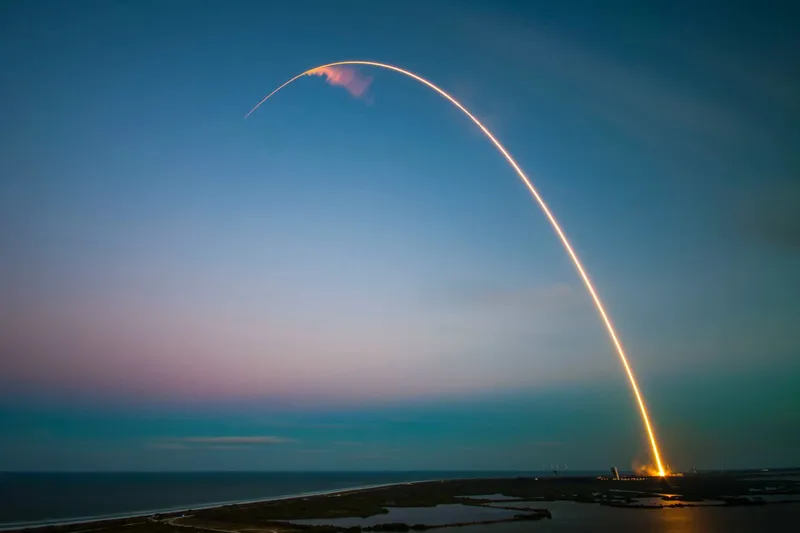
Space Location Tracking
For space location tracking to work in a similar way to the way it does on Earth, celestial objects or any man-made space tech need to be tracked relative to an object. This becomes much simpler when what you're tracking is in the orbit of said object.
In other words, there is no x, y or z axes in space where there are on Earth. Any object on Earth has a latitude, a longitude and an altitude. This is how conventional GPS asset management works - it gives you where an asset is in terms of x,y,z or latitude, longitude and altitude.
Therefore, to track an object in space, we can use the same logic where if something is 65 miles above sea level above the white house, the coordinates are 38.8977º North, 77.0365º West, and 65 miles upwards. In other words, this tracking still works relative to Earth.
However, this creates a world of difficulties as the White House will move at the same rate as the Earth's spin and the Earth's orbit around the sun, where these two factors will affect how easy it is to track things in space. In other words, if the White House is "still", the x,y,z coordinates do not change, where they do for a space-craft.
Overcoming Space Tracking Difficulties
You'll have likely heard that there's more technology in your smartphone than put us on the moon. Therefore, how is it that your smartphone can track your IT assets but find difficulty in tracking space objects?
The answer is simple: Maths. The way you overcome location tracking difficulties within anything tracking space objects, from your smartphone to your laptops to your own imagination is with maths.
As you can still bounce signals to and from space objects, you can track them mathematically at a given moment. What does this involve? A lot of factors.
The most simple part is when you're closer to the answer, you can bounce a signal off a space object to get a hypotenuse. Then, if you know that object's altitude you can use Pythagoras' theorem to find out x,y. The difficulty here is that you need to position multiple signal trackers so that none of them need to pass a signal through Earth. The signal also needs to be sent and bounce at the correct angle, as it must be a straight line to and from the tracker.

Yet, to get more specific and granular you need to do the more complex maths including the speed and direction of travel, the current velocity of the ship, the angle of the orbit, the shape of the orbit to find out the altitude of the ship. Once you know all of this, you've calculated the position anyway.
Therefore, it's essentially "find x", "find y", "find z" and, using tracking technologies, you can fill in the gaps to reduce the number of unknown variables.
This can still present difficulties. For example, as the ISS was built in space, there were a lot of unknowns based on whether or not the GPS receivers they built will work. It is still the best way to fill in the gaps as now, instead of having pages and pages and pages of formulae to track every element involved in space travel (including pitch, yaw, velocity, etc.), we can use technology to feed us that information.