It’s 2am. Your office is empty. Your warehouse is locked. Your construction site is dark.
And somewhere, quietly, an AI agent is going through every single asset in your itemit register.
It’s checking last scan times. Cross-referencing locations. Flagging anything that hasn’t moved in 60 days. Identifying equipment that left Site A but never arrived at Site B. Catching the ghost assets that have been on your books for three years but nobody has physically seen since the last office move.
By the time your operations manager arrives at 8am, there’s a report waiting in itemit. Clean. Specific. Actionable.
Nobody stayed late. Nobody ran a script. Nobody remembered to do it.
This isn’t a concept anymore. This is what agentic AI looks like pointed at itemit’s asset register. And it’s changing what operations teams think is even possible.

How Autonomous Agents Catch What Manual Audits Miss
Manual audits have a structural problem. They are a snapshot. Someone walks around, scans things, compares what they find to what the system says, and produces a report. The moment that report is finished it starts going out of date. Assets move. People leave. Equipment gets borrowed. The register drifts again immediately.
An autonomous agent doesn’t take snapshots. It watches continuously. Every asset in itemit has a last-seen timestamp, a last-known location, an assigned custodian. The agent monitors all of it simultaneously, around the clock. It doesn’t check once a quarter. It checks constantly.
That’s the fundamental difference. A manual audit catches what was wrong at the moment someone looked. An autonomous agent catches what goes wrong the moment it happens.
The specific things it finds that manual audits routinely miss: assets assigned to employees who have left the company but never been reallocated. Equipment that left one site but never arrived at another. Items in heavy rotation with no maintenance records attached. Duplicate records for the same piece of equipment entered under two different reference numbers. Ghost assets that haven’t been physically seen in months but are still attracting depreciation on the books.
itemit was built to close that gap. Every scan, every checkout, every location update flows into a live register in real time. But what happens when you connect that live register to an AI agent that never stops watching it?
How Autonomous AI Works With an Asset Tracking System Like itemit
An AI agent isn’t a chatbot. It doesn’t wait for you to ask it something.
It has a goal. It has access to your systems. And it acts repeatedly, autonomously, without being told to, until the goal is achieved or something needs a human decision.
The frameworks making this possible right now are things like OpenClaw, which lets developers wire LLMs directly into business systems and give them real permissions to read, write, and act. Pair that with an LLM like Claude or Gemini that can reason across complex datasets, connect it to itemit’s API, and you have something that understands your asset register the way a senior ops manager would. Except it never sleeps and it never forgets.
The connection layer is where MCP comes in. Model Context Protocol lets an AI agent talk directly to itemit without custom integration work for every system. Point an MCP-enabled agent at itemit’s API and it can read your full asset register, query locations, check maintenance schedules, and write updates back in real time. No manual exports. No middleware. The agent works directly inside itemit with your live data.

Give it a brief: keep the itemit register accurate, flag anything unusual, escalate anything urgent.
Here’s what it does with that brief.
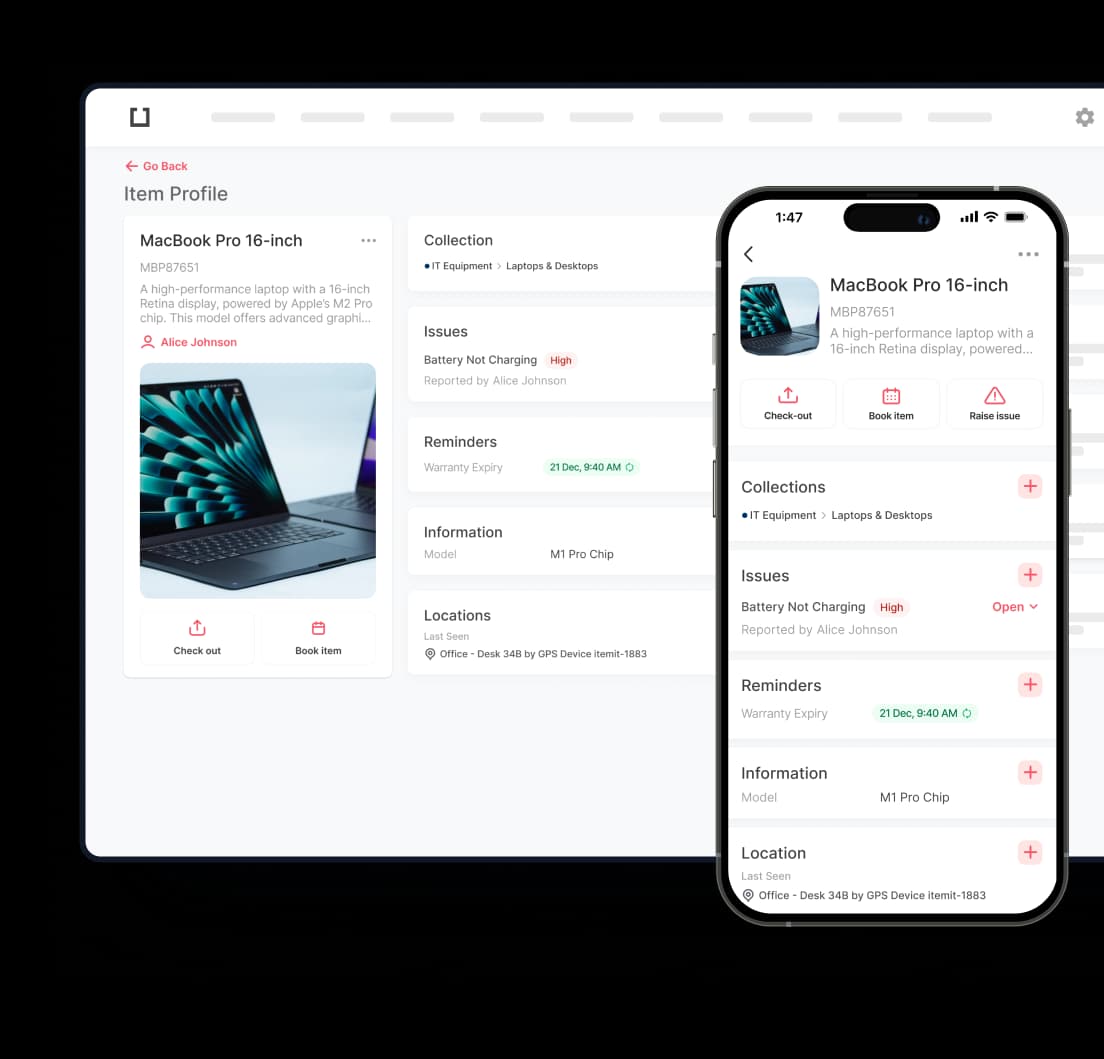
First, it reconciles constantly. Every asset in itemit has a last-seen timestamp, a last-known location, an assigned custodian. The agent monitors all of it simultaneously, around the clock. No human team could do this at the same resolution without dedicating entire headcount to the task.
Then it starts connecting dots across itemit’s data. An asset that hasn’t been scanned in 45 days isn’t automatically a problem. But an asset that hasn’t been scanned in 45 days, whose last location was a site that closed last month, whose assigned custodian left the company two weeks ago? That’s a pattern. A human might spot it eventually. The agent spots it at 2am on a Wednesday and flags it in itemit before anyone arrives.
It also works across locations simultaneously. Say Site A submits a purchase request for two additional monitors. Before that request gets approved, the agent checks itemit’s utilisation data across every site. Site C has four monitors logged as inactive. The agent flags the internal transfer opportunity and the procurement cost never hits the budget.
On the maintenance side, it tracks every asset in itemit against its service schedule. Hours, usage cycles, calendar intervals. When a generator hits 340 hours and the service threshold is 350, the agent doesn’t wait for someone to notice. It schedules the maintenance, notifies the engineer, and logs it directly in the itemit asset record. Three days before the breakdown that would have cost a week of downtime.
And for ghost assets, anything that appears in itemit but shows no activity for an extended period gets flagged for physical verification. Not deleted. Flagged. The agent knows the difference between an asset in long-term storage and one that simply doesn’t exist anymore.